

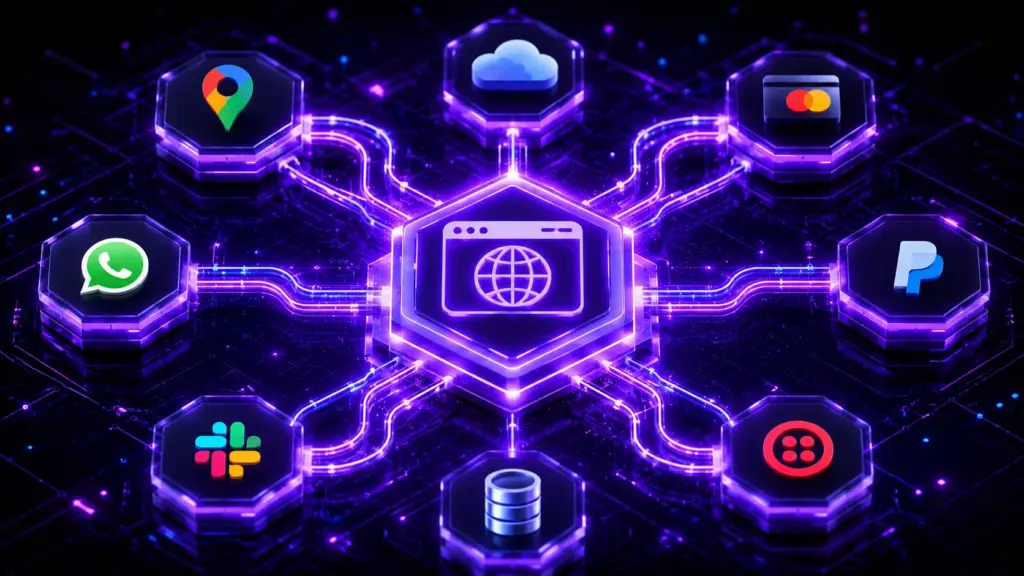
Most modern websites don’t work alone. They talk to payment gateways, CRMs, messaging tools, and maps behind the scenes. That’s where API integration web development Hyderabad businesses rely on comes in.
As an API integration company in Hyderabad, we connect these systems every week. Here’s what makes an integration solid instead of fragile.
What Is an API Integration?
An API is a contract between two systems. It lets your website ask a payment gateway to confirm a charge, or push a new lead into your CRM automatically.
Without integrations, someone has to copy that data by hand. That’s slow. It’s also where errors creep in.
Common Integrations Businesses Need in 2026
Most businesses need a handful of connections to run smoothly:
- CRM sync — auto-push form leads into your sales pipeline
- Payment gateways — process transactions through providers like Stripe
- WhatsApp Business API — send automated order updates via Twilio
- Google Maps — power store locators and delivery tracking with Google’s developer platform
- Email marketing tools — sync subscribers for automated nurture sequences
Each one saves hours of manual work every week.
REST vs GraphQL: Which Should You Use?
REST is the industry default. It uses standard HTTP methods and predictable endpoints. Most third-party tools support it out of the box.
GraphQL lets your app request exactly the fields it needs in one query. That’s useful for complex apps pulling data from many sources.
For most business integrations — payments, CRM, messaging — REST is still the practical choice. That’s simply what most providers expose.
Keep Your API Keys Secure
Never expose API keys in frontend code. Anyone can view your page source and find them there.
Instead, store keys as environment variables on your server. Only your backend should touch them.
So rotate your keys regularly. Use scoped tokens with minimal permissions, not full-access master keys. That way, a leaked key does far less damage.
Handle Rate Limits and Errors Gracefully
Third-party APIs enforce rate limits to prevent abuse. Your integration needs to respect that.
Build in retry logic with exponential backoff instead of hammering a failed request repeatedly. Log every failure. Set up alerts for repeated ones.
This is what separates a production-grade integration web development Hyderabad teams build from one that quietly breaks during a brief outage.
Test and Document Every Integration
Use Postman to test API requests before wiring them into your app. It catches authentication and payload issues early, before they reach production.
If your team builds and exposes its own APIs, document them using Swagger/OpenAPI standards. That makes future maintenance far easier — for your team and any partners.
Choosing the Right Third-Party Service
Not sure which provider to pick? RapidAPI is a solid marketplace for comparing options, pricing, and documentation quality before you commit.
How NRS Technologies Handles API Integrations
We build every integration with error handling, retry logic, and monitoring from day one. That’s not an afterthought bolted on after something breaks.
As a result, your dashboards and automated workflows keep working — even when a third-party service has a brief hiccup. Explore our full web development services to see how we approach integration-heavy builds.
Frequently Asked Questions
What’s the difference between REST and GraphQL APIs? REST uses fixed endpoints and standard HTTP methods. It’s the most widely used approach. GraphQL lets clients request exactly the fields they need in one flexible query, which helps complex apps avoid over-fetching data.
Where should API keys be stored securely? Store them in server-side environment variables. Never place them in frontend code, where anyone viewing your page source could find them.
What happens if a third-party API integration fails? A well-built integration includes retry logic, error logging, and alerts. That way, failures get caught and handled instead of silently breaking your app.
How long does a typical API integration take to build? A single payment gateway might take a few days. Complex, multi-system integrations with custom logic can take several weeks, depending on scope.
Do I need to rotate my API keys regularly? Yes. Regular rotation and scoped, minimal-permission tokens limit the damage if a key is ever compromised.
Can multiple third-party services run reliably on one website? Yes. With solid architecture, error handling, and monitoring, sites commonly run many integrations at once. Each one adds some complexity, but it’s manageable with the right setup.
Final Thoughts
API integrations are the connective tissue of a modern website. They turn manual, error-prone processes into automatic ones.
Build them with security and error handling from the start. That way, a small third-party hiccup never turns into a major business disruption.
Ready to get started? Contact NRS Technologies at hello@nrstechnologies.com or visit nrstechnologies.com/contact for a free integration consultation.