
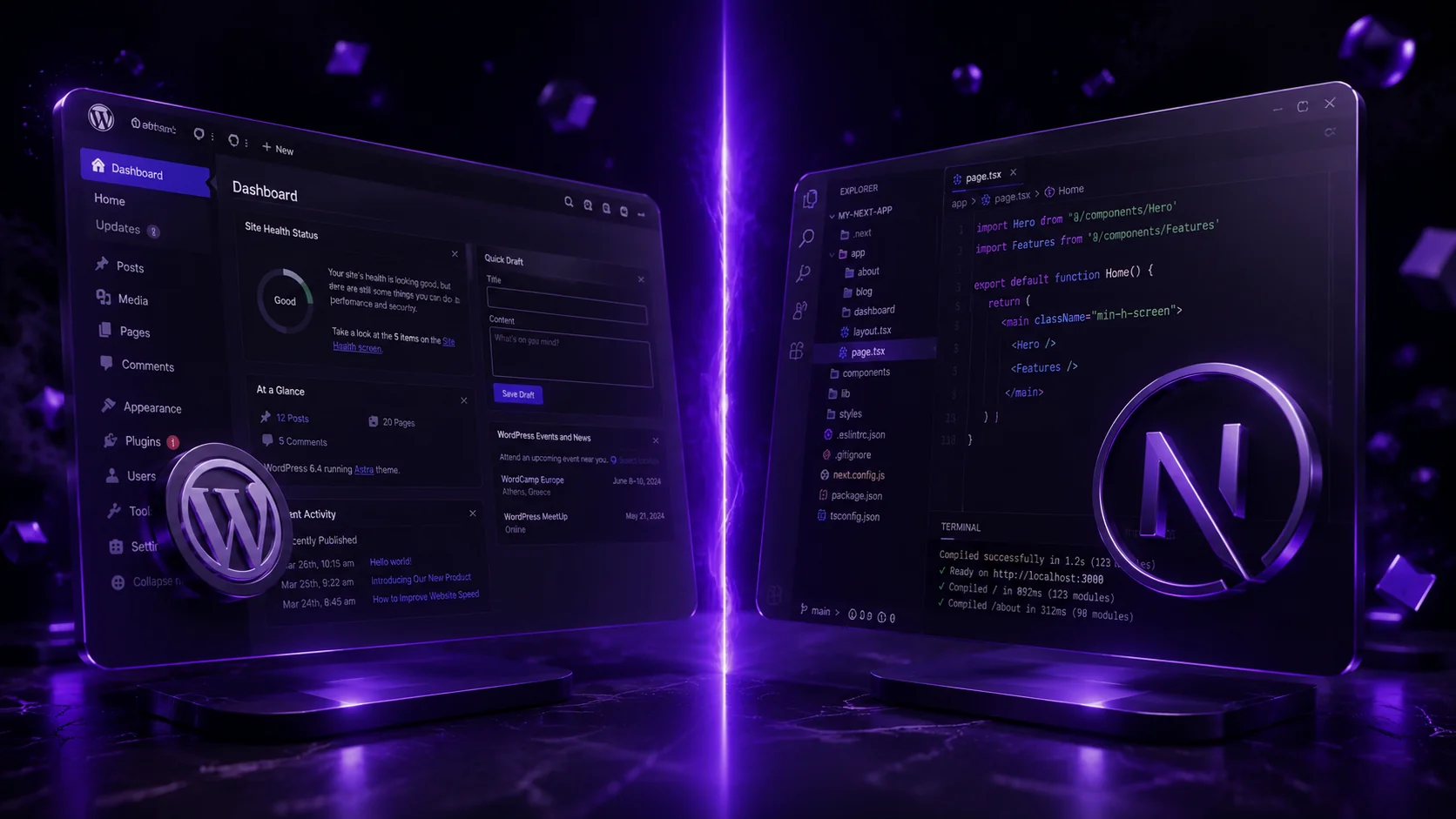
Choosing between WordPress and Next.js shapes your website’s flexibility, speed, and maintenance for years, not just at launch. That’s why WordPress vs Next.js website Hyderabad businesses debate deserves a genuinely honest comparison, not a one-size-fits-all recommendation.
As a website design company in Hyderabad building on both platforms regularly, here’s how they actually compare.
What WordPress Offers
WordPress powers a massive share of the web, backed by an enormous plugin ecosystem covering nearly any functionality imaginable. Content editing is genuinely accessible to non-technical team members, making WordPress a strong fit for businesses that update content frequently without developer involvement.
This accessibility comes with tradeoffs though. Plugin-heavy sites can accumulate performance and security overhead over time if not carefully maintained.
What Next.js Offers
Next.js delivers exceptional performance through server-side rendering and static generation, giving developers precise control over speed and SEO optimization. For businesses prioritizing page speed and custom functionality, Next.js typically outperforms a standard WordPress setup.
The tradeoff here is accessibility. Content updates generally require developer involvement unless paired with a headless CMS, unlike WordPress’s built-in editing experience.
Content Editing Experience Compared
WordPress’s editor lets marketing teams publish and update content independently, without waiting on developer availability. Next.js sites need either custom-built admin tooling or a headless CMS layered on top to achieve similar non-technical editing capability.
So if your team publishes content frequently and independently, this difference matters significantly for day-to-day operational speed.
Performance and Speed Comparison
Next.js generally wins on raw performance, particularly for content-heavy, SEO-critical pages, thanks to its rendering flexibility and built-in optimization. A well-optimized WordPress site can still perform well, but achieving Next.js-level speed typically requires more deliberate technical effort and hosting investment.
SEO Capabilities
Both platforms can rank well when properly configured. WordPress’s plugin ecosystem (Yoast, Rank Math) makes SEO accessible to non-technical users, while Next.js gives developers more granular, code-level control over technical SEO implementation.
Development and Maintenance Costs
WordPress often has lower upfront development costs given its extensive plugin availability, but ongoing maintenance — security patches, plugin updates — remains an active, recurring responsibility. Next.js typically has higher upfront development cost but often lower ongoing maintenance overhead once built.
When WordPress Makes More Sense
Content-heavy sites with frequent, independent editorial updates, and businesses without dedicated developer resources for ongoing changes, generally fit WordPress better. Blogs, small business sites, and content-marketing-focused websites often work well here.
When Next.js Makes More Sense
Performance-critical sites, custom web applications, and businesses with dedicated development resources for ongoing changes typically benefit more from Next.js. eCommerce platforms and SaaS marketing sites needing precise performance control often lean this direction.
How NRS Technologies Chooses the Right Platform
We evaluate content update frequency, team technical resources, and performance priorities before recommending a specific platform for each client project. Our website design services cover both WordPress and Next.js builds, matched to actual business needs rather than a default preference.
As a result, clients get a platform genuinely suited to how they’ll operate the site long-term, not just what’s trending. Our Website AMC services also support ongoing maintenance regardless of which platform fits your project.
Frequently Asked Questions
Is WordPress or Next.js better for SEO? Both can rank well when properly configured. WordPress’s plugin ecosystem makes SEO accessible to non-technical users, while Next.js offers more granular, code-level SEO control for developers.
Which platform is easier for non-technical teams to update? WordPress, since its built-in editor allows independent content publishing without developer involvement, unlike Next.js which typically requires either developer support or a headless CMS layer.
Does Next.js always load faster than WordPress? Generally, Next.js has performance advantages by default, though a well-optimized WordPress site with proper caching and hosting can still perform competitively for many use cases.
Which platform costs less to maintain long-term? It varies. WordPress often has lower upfront costs but ongoing plugin and security maintenance responsibility, while Next.js typically costs more upfront but often less in ongoing maintenance once built.
Can WordPress and Next.js be combined in one project? Yes, using WordPress as a headless CMS with a Next.js frontend combines WordPress’s content editing accessibility with Next.js’s performance advantages, though this adds architectural complexity.
Which platform is better for an eCommerce website? It depends on scale and customization needs. WordPress with WooCommerce suits many standard eCommerce needs, while Next.js with custom or headless commerce suits businesses needing precise performance control at scale.
Final Thoughts
Neither platform is universally better — the right choice depends on how frequently your team updates content and how much you prioritize raw performance versus editorial independence. Matching the platform to your actual operational needs matters more than following trends.
Ready to get started? Contact NRS Technologies at hello@nrstechnologies.com or visit nrstechnologies.com/contact for a free platform consultation.