
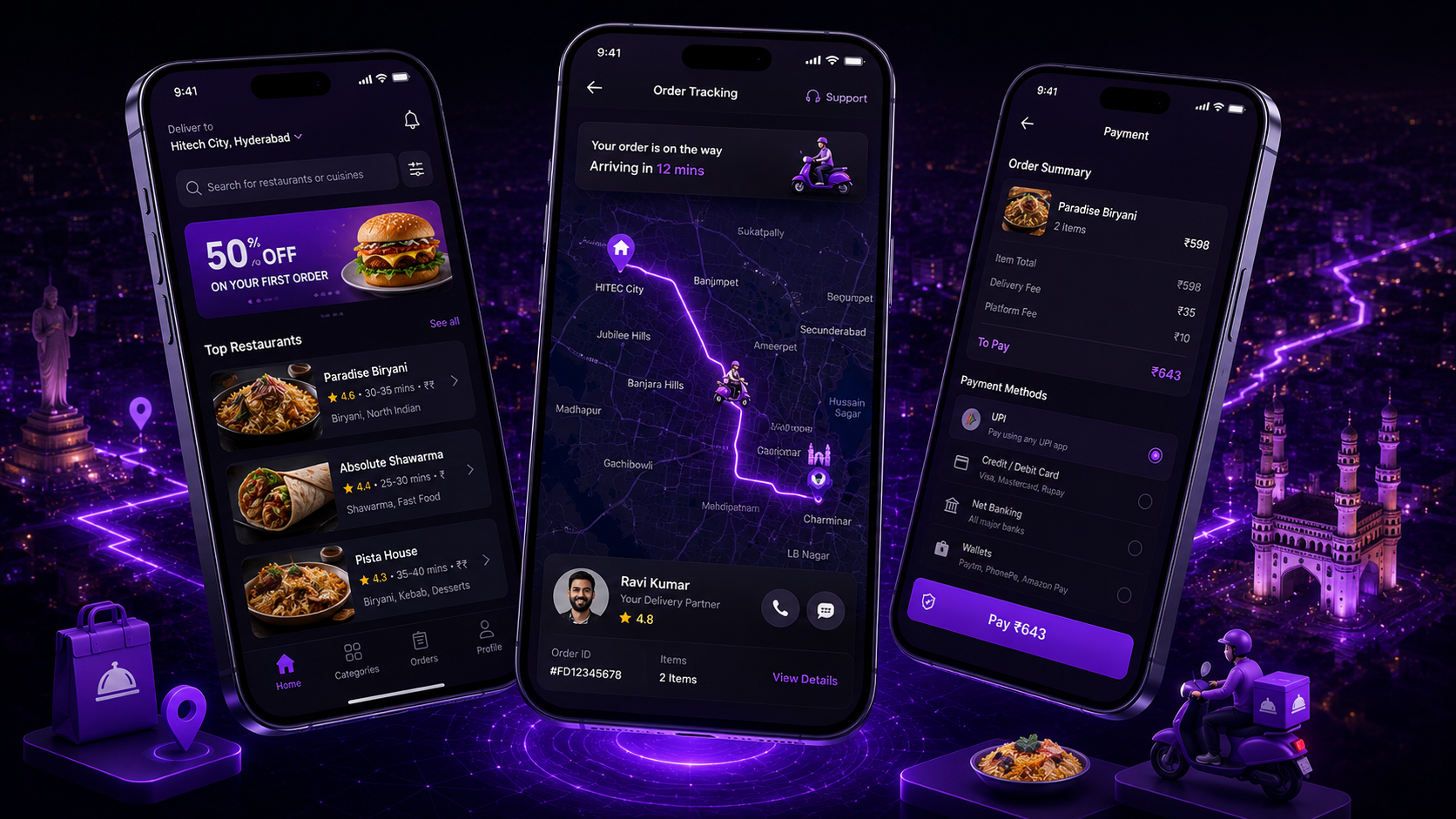
The food delivery market in India has produced some of the country’s biggest consumer tech success stories, and demand for regional, niche, and hyperlocal delivery apps continues to grow. As a food delivery app development company in Hyderabad, here’s the realistic breakdown of what it actually takes to build one in 2026.
The Food Delivery App Market in India
India’s online food delivery sector has grown into one of the largest consumer internet categories in the country, with continued expansion into tier-2 and tier-3 cities. Statista’s food delivery market outlook tracks this growth and is a useful reference for sizing the opportunity in a specific city or region before committing to a build.
Core Features You Need
A functioning food delivery platform requires four connected apps, not one:
- Customer App — browsing, ordering, live tracking, payments
- Restaurant Panel — menu management, order acceptance, status updates
- Delivery Partner App — order assignment, navigation, earnings tracking
- Admin Dashboard — order oversight, restaurant onboarding, analytics, dispute resolution
Skipping any one of these four typically means expensive rework once the platform starts scaling.
Recommended Technology Stack
- Frontend: React Native for cross-platform customer and delivery apps
- Backend: Node.js for real-time, high-concurrency order handling
- Real-time infrastructure: Firebase or Socket.io for live order tracking
- Maps and routing: Google Maps Platform for delivery tracking and route optimization
- Payments: Razorpay for UPI, cards, wallets, and COD reconciliation
Real-Time Tracking Implementation
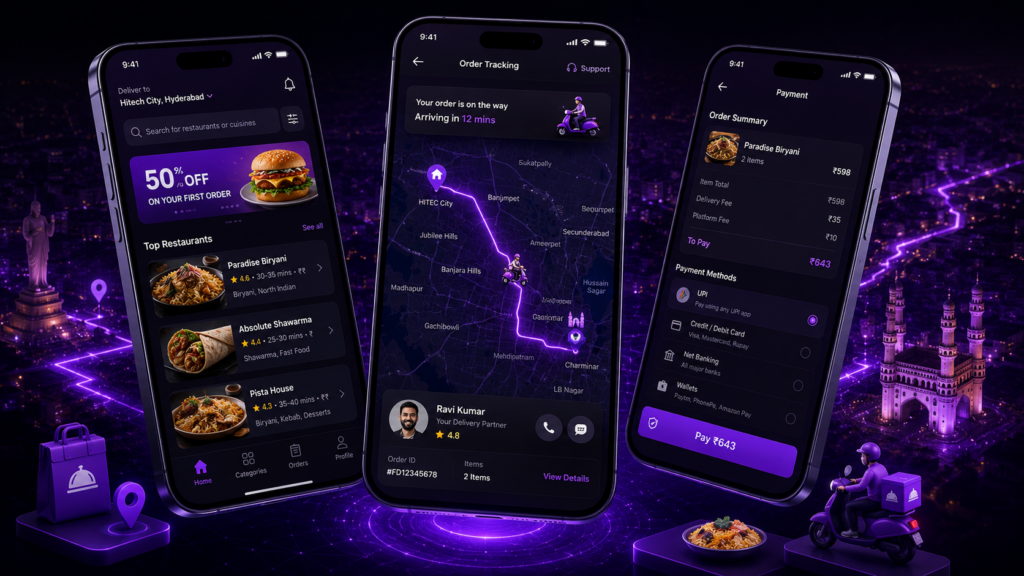
Live order tracking is what customers expect by default now — not a premium feature. This requires a persistent connection between the delivery partner’s app and the customer’s app, typically implemented via WebSockets or a real-time database, updating location every few seconds without draining battery excessively.
Payment Integration
Supporting UPI, major cards, popular wallets, and Cash on Delivery simultaneously is table stakes for the Indian market. Reconciliation between online payments and COD collections needs to be built into the admin dashboard from day one, not added later.
Cost and Timeline Breakdown
A production-ready MVP covering all four apps typically requires several months of development, depending on feature scope and how much customization is needed beyond core ordering and tracking functionality. Costs scale with the complexity of restaurant onboarding workflows, delivery logistics algorithms, and third-party integrations required.
How NRS Technologies Builds Food Delivery Apps
We start with a scoped MVP covering the core ordering-to-delivery loop, then layer in advanced features like scheduled orders, loyalty programs, or multi-restaurant cart support based on real usage data rather than building every possible feature upfront. Technical patterns referenced in the Swiggy Engineering blog offer useful insight into how mature platforms handle scale challenges as order volume grows.
Frequently Asked Questions
How long does it take to build a food delivery app? A scoped MVP covering customer, restaurant, delivery partner, and admin apps typically takes several months, depending on feature complexity and integrations required.
Do I need separate apps for customers and delivery partners? Yes, customers and delivery partners have fundamentally different needs (browsing and ordering vs navigation and order management), so separate, purpose-built apps perform better than a single combined app.
What’s the biggest technical challenge in food delivery apps? Real-time order tracking and delivery partner assignment logic at scale are typically the most complex components, requiring careful backend architecture from the start.
Can I launch in one city first and expand later? Yes, this is generally the recommended approach — validating the model in one city or region before investing in multi-city logistics complexity.
Final Thoughts
Building a food delivery app is less about the ordering screen and more about the operational complexity behind it — real-time tracking, delivery logistics, and multi-sided marketplace dynamics. Getting the architecture right from day one saves significant rework later.
Ready to get started? Contact NRS Technologies at hello@nrstechnologies.com or visit nrstechnologies.com/contact for a free app scoping session.