
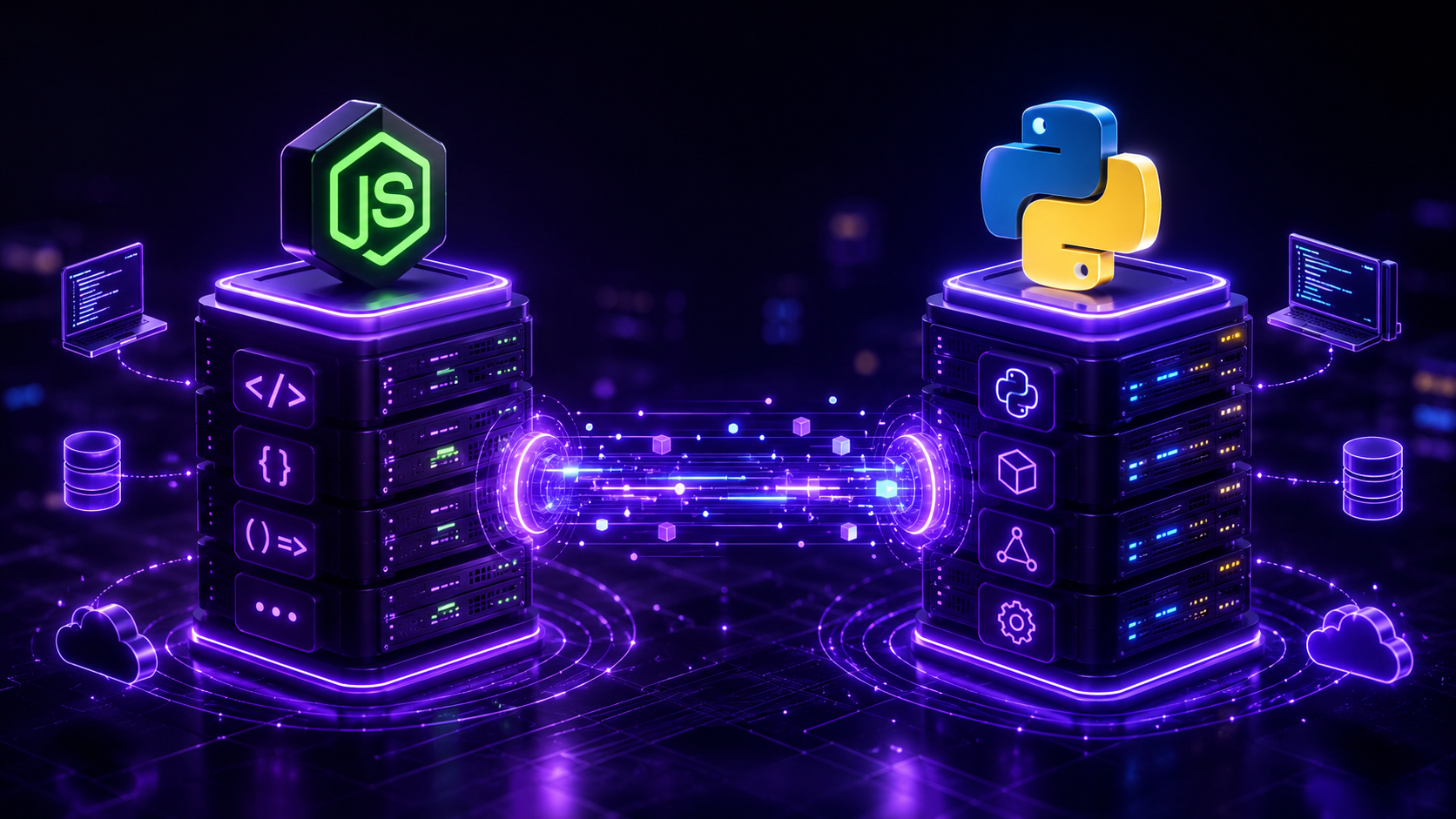
Every serious web project eventually needs a backend, and the choice between Node.js and Python shapes everything from hiring to performance to how easily your product can scale. As a backend development company in Hyderabad, here’s how we help clients make this call in 2026.
Overview of Backend Development in Modern Web Apps
The backend handles everything users don’t see directly — business logic, database interactions, authentication, and API responses that power your frontend. Choosing the right language and framework early avoids expensive rewrites as your product grows.
Node.js: Performance, Real-Time Capabilities, and Ecosystem
Node.js runs JavaScript on the server, making it a natural fit for teams already using JavaScript on the frontend. Its non-blocking, event-driven architecture makes it especially strong for real-time applications — chat, live tracking, notifications — where many concurrent connections need to be handled efficiently. Frameworks like Express keep the learning curve manageable, and the massive npm ecosystem means most common integrations already have a well-maintained package available.
Python: Django, Flask, and FastAPI Use Cases
Python shines in data-heavy and AI/ML-adjacent applications, thanks to its dominant ecosystem for machine learning, data science, and automation. Django offers a batteries-included framework for rapid development of admin-heavy applications, Flask provides lightweight flexibility, and FastAPI has become increasingly popular for building fast, well-documented APIs with modern async support.
Performance Benchmarks in 2026
Node.js generally outperforms Python for I/O-heavy workloads — handling many simultaneous requests without blocking — thanks to its event loop architecture. Python, particularly with async frameworks like FastAPI, has closed much of this gap for API workloads, though it still trails Node.js in raw concurrent connection handling for real-time use cases.
When to Use Node.js
- Real-time features: chat, live tracking, notifications
- APIs serving a JavaScript/React or Next.js frontend
- Microservices architectures needing lightweight, fast-starting services
- Teams wanting a single language across frontend and backend
When to Use Python
- AI/ML-integrated applications
- Data-heavy platforms requiring analysis, reporting, or automation
- Rapid prototyping with Django’s built-in admin and ORM
- Teams already invested in Python for data science workflows
How NRS Technologies Uses Node.js for Full-Stack Projects
For most client projects — particularly those paired with a Next.js frontend — we default to Node.js, since it keeps the entire stack in one language, simplifies hiring, and handles real-time features natively. We pair it with MongoDB for flexible, document-based data or PostgreSQL for relational data needing strong consistency, depending on the project’s data model.
Frequently Asked Questions
Is Node.js faster than Python? For I/O-heavy, high-concurrency workloads, Node.js generally outperforms Python due to its non-blocking event loop architecture, though the gap narrows significantly with async Python frameworks like FastAPI.
Which is better for building an API: Node.js or Python? Both are strong choices. Node.js is often preferred when paired with a JavaScript frontend for language consistency, while Python is preferred when the API needs to integrate with machine learning or data science workflows.
Can I use both Node.js and Python in the same project? Yes, many production systems use Node.js for the main application backend and Python as a separate microservice for AI/ML-specific tasks.
Is Python better for startups building AI features? Generally yes, since Python has the most mature ecosystem for machine learning libraries and AI integrations.
Final Thoughts
There’s no universally “faster” language — the right choice depends on your product’s core workload. Real-time, high-concurrency products lean Node.js; data and AI-heavy products lean Python.
Ready to get started? Contact NRS Technologies at hello@nrstechnologies.com or visit nrstechnologies.com/contact for a free backend architecture consultation.