
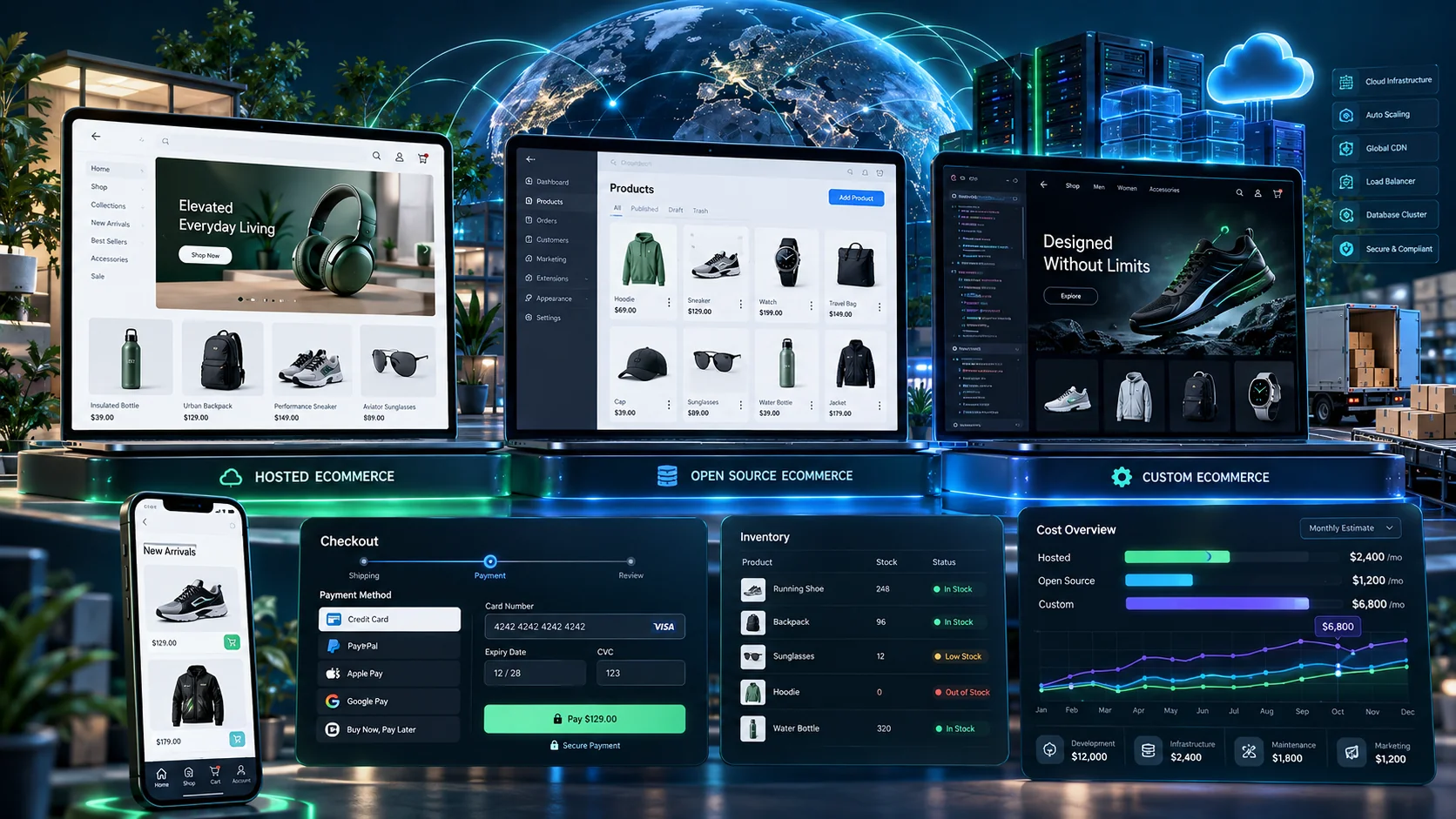
How much does an ecommerce website cost in 2026?
The honest answer is:
It depends on whether you need a store, a sales system or an entire commerce platform.
A small Shopify store using an existing theme costs far less than a multi-vendor marketplace with custom inventory, payments, shipping, ERP integration and mobile applications.
That is why comparing ecommerce development quotes without comparing scope creates confusion.
This guide explains the eCommerce website development cost in 2026, including Shopify, WooCommerce and custom ecommerce platforms.
We will also cover the hidden costs many businesses forget before launch.
How Much Does an eCommerce Website Cost in 2026?
For early budgeting, projects often fall into broad categories like these:
| Type of eCommerce Project | Indicative Development Budget |
|---|---|
| Basic theme-based online store | ₹40,000 – ₹1.2 lakh |
| Professional Shopify / WooCommerce store | ₹1 lakh – ₹3 lakh |
| Highly customized eCommerce website | ₹2.5 lakh – ₹7 lakh+ |
| Custom eCommerce application | ₹4 lakh – ₹12 lakh+ |
| Multi-vendor marketplace | ₹5 lakh – ₹20 lakh+ |
| Enterprise / headless commerce | Scope-based |
These are planning ranges rather than quotations. Actual budgets depend on design, features, integrations, catalogue size, business rules and infrastructure.
Current Indian agency listings on Clutch show ecommerce projects across a very wide range, including projects below $10,000, $10,000–$49,000 and significantly larger implementations.
You can review the current India ecommerce development market listings on Clutch.
What Determines eCommerce Development Cost?
The platform matters.
However, features matter even more.
Two Shopify stores can use exactly the same subscription plan and still have completely different development budgets.
One may use a standard theme.
The other may require:
- Custom product templates
- Wholesale pricing
- ERP integration
- Custom checkout logic
- Multiple languages
- International pricing
- Advanced search
- Subscriptions
- Custom customer accounts
Therefore, start with the business workflow rather than the platform name.
Shopify Pricing in 2026
Shopify is one of the fastest ways to launch a professional online store.
As of September 2026, Shopify India’s annual billing rates list:
| Plan | India Annual Billing Rate |
|---|---|
| Basic | ₹1,499/month |
| Grow | ₹5,599/month |
| Advanced | ₹22,680/month |
| Plus | From ₹1,75,000/month |
Always check the current Shopify India pricing page because prices and promotional offers can change.
For international businesses, Shopify’s US annual rates currently start at $29/month for Basic, $79 for Grow and $299 for Advanced.
However, your subscription is not your total ecommerce budget.
What Does a Shopify Store Actually Cost?
A Shopify implementation can contain several separate costs.
These include:
- Shopify subscription
- Domain
- Theme
- Design
- Development
- Apps
- Payment fees
- Custom integrations
- Maintenance
- Marketing
Shopify’s own 2026 ecommerce website cost guide also notes that apps, premium design, domains, integrations and transaction costs can increase the total budget beyond the platform subscription.
When Is Shopify the Right Choice?
Shopify is a strong option when a business wants:
- Fast setup
- Managed hosting
- Reliable checkout
- Easy product management
- A large app ecosystem
- Lower infrastructure responsibility
It works particularly well for D2C brands and retailers that want to focus on selling rather than server management.
Businesses that need Shopify setup, customization or integrations can review our eCommerce development services.
What Does WooCommerce Development Cost?
WooCommerce works differently.
The core plugin itself is open source.
However, the total website still requires:
- WordPress hosting
- Domain
- Theme or custom design
- Development
- Security
- Backups
- Plugin licenses
- Maintenance
Therefore, “WooCommerce is free” does not mean “a professional WooCommerce store costs nothing.”
The platform license is only one piece of the project.
When Is WooCommerce a Good Choice?
WooCommerce can make sense when:
- Your business already uses WordPress.
- Content marketing is important.
- You need strong CMS flexibility.
- Your workflow fits the WordPress ecosystem.
- You want more control over hosting.
However, plugin compatibility and ongoing maintenance need careful management.
Shopify vs WooCommerce Cost
| Factor | Shopify | WooCommerce |
|---|---|---|
| Platform fee | Monthly subscription | Core plugin is free |
| Hosting | Included | Separate |
| Security infrastructure | Mostly managed | More owner responsibility |
| Apps / plugins | Often subscription-based | Free and paid options |
| Customization | Strong, within platform | Very flexible |
| Maintenance | Lower platform maintenance | Core, theme and plugin maintenance |
Neither platform is automatically cheaper.
The correct choice depends on what you need the store to do.
When Do You Need a Custom eCommerce Platform?
Sometimes Shopify or WooCommerce is not enough.
For example, your business may require:
- Complex vendor workflows
- Country-specific inventory
- Custom pricing engines
- Unusual payment logic
- Complex B2B processes
- Custom settlement systems
- Special ERP integrations
- Advanced permissions
- Large-scale APIs
In those cases, custom software can fit the workflow more closely.
Our custom web development team can build frontend, backend, database and integration layers when an off-the-shelf store becomes too restrictive.
What Does a Multi-Vendor Marketplace Cost?
A marketplace is much more complex than a normal online shop.
A traditional store usually has:
Business → Customer.
A marketplace may have:
Platform → Vendor → Customer → Shipping Provider → Payment System.
That creates additional workflows.
Typical marketplace functionality includes:
- Vendor registration
- Vendor approval
- Vendor dashboards
- Commission calculations
- Order splitting
- Vendor inventory
- Returns
- Cancellations
- Settlement tracking
- Coupons
- Reviews
- Disputes
Each feature adds business logic and testing requirements.
Therefore, marketplaces usually require a larger development budget than standard stores.
How Much Does Custom eCommerce UI/UX Cost?
A theme can reduce design costs.
However, many established brands need a more distinctive customer experience.
A custom design project may include:
- Customer research
- Information architecture
- Wireframes
- Homepage design
- Collection pages
- Product pages
- Cart
- Checkout journeys
- Customer accounts
- Mobile layouts
Our eCommerce UI/UX design services focus on customer journeys rather than visual decoration alone.
Why Mobile Design Matters to eCommerce Cost
A store should not simply shrink its desktop interface onto a mobile screen.
Mobile commerce requires careful decisions around:
- Navigation
- Product images
- Variants
- Add to Cart
- Checkout
- Forms
- Payment methods
This is particularly important because many consumers discover and purchase products through mobile devices.
You can read our guide to mobile-first website design for more detail.
Payment Gateway Integration Costs
Payment integration sounds simple.
However, the actual implementation may require:
- Successful payment handling
- Failed payment handling
- Webhook verification
- Refunds
- Partial refunds
- COD
- Payment-status reconciliation
- Fraud handling
Common providers include Stripe, Razorpay, PayPal and platform-native payment systems.
A standard integration may be straightforward.
A custom marketplace payment workflow can be much more complicated.
Shipping Integration Costs
Shipping is another area where project complexity increases quickly.
A basic store may only need a fixed shipping fee.
An advanced store may need:
- Courier API integration
- Real-time shipping rates
- Multiple warehouses
- Shipment tracking
- Return shipping
- Exchange shipping
- Delivery-area restrictions
Therefore, define your fulfilment process before finalizing a development budget.
Inventory Integration Costs
A small store can manage products directly inside Shopify or WooCommerce.
A larger retailer may need to synchronize inventory across:
- Website
- Physical stores
- Marketplaces
- Warehouses
- ERP
Real-time synchronization requires APIs, error handling and reconciliation logic.
That increases development effort.
What Are the Hidden Costs of an eCommerce Website?
Development is only part of the total cost.
Businesses should budget for ongoing expenses too.
Apps and Plugins
Reviews, loyalty, subscriptions, search, analytics and marketing tools often have recurring charges.
Payment Processing
Payment providers normally charge transaction fees.
Hosting
Shopify includes hosting.
WooCommerce and custom platforms need separate infrastructure.
Maintenance
Stores need updates, monitoring and occasional development support.
Marketing
A technically perfect store with no acquisition strategy can still produce no sales.
Our digital marketing services cover SEO, content and performance-focused growth strategies once the store is ready to acquire customers.
Do You Need a Headless eCommerce Website?
Not automatically.
Headless commerce separates the customer-facing frontend from the commerce backend.
This can provide greater flexibility.
However, it also increases architectural complexity.
Use it when you have a genuine reason.
For example:
- You need highly custom customer experiences.
- You serve several channels from one backend.
- Your existing storefront limits performance or design.
- Your frontend team needs independent release control.
Our guide to headless commerce development explains when that architecture makes sense.
Theme Store vs Custom Store: Which Costs Less?
A theme-based store costs less initially.
That makes it a sensible choice for many new brands.
However, repeated modifications can eventually create technical debt.
A custom design costs more at the beginning.
In return, you get greater control over the user experience.
The right decision depends on the business stage.
Do You Need a Mobile App Too?
Not every online store needs an app.
A fast mobile website may be enough at the beginning.
A dedicated application becomes more useful when you need:
- Push notifications
- Loyalty features
- High repeat-purchase frequency
- Offline functionality
- Device features
Businesses considering this route can explore our mobile app development services.
How to Reduce eCommerce Development Cost Without Hurting Quality
The easiest way is not to negotiate every development hour.
Reduce unnecessary scope.
For example, ask:
- Do we need a mobile app at launch?
- Can we use a reliable existing payment system?
- Do we need custom search immediately?
- Can a theme validate the business first?
- Which integrations are essential for launch?
Building fewer useful features usually saves more money than hiring the cheapest possible developer.
What Should Be Included in an eCommerce Development Quote?
A professional proposal should make the scope clear.
Look for:
- Discovery
- UI/UX design
- Frontend development
- Backend work
- Platform setup
- Payment integration
- Shipping integration
- Testing
- Deployment
- Post-launch support
Also ask which third-party subscription costs are excluded.
How Long Does eCommerce Development Take?
Simple stores can launch relatively quickly.
Complex platforms need more time.
A realistic process often includes:
Discovery → Design → Development → Integration → QA → Launch.
NRS Technologies currently positions its eCommerce development service around custom stores, Shopify, WooCommerce, payment gateways, inventory and multi-vendor solutions.
How to Choose an eCommerce Development Company
Do not compare agencies only by price.
Ask:
- Have you built similar workflows?
- Who handles UI/UX?
- How do you test checkout?
- Who manages deployment?
- Who owns the source code?
- How are integrations tested?
- What happens after launch?
Then review actual work.
You can explore our NRS Technologies portfolio to see examples across web, ecommerce, mobile and software products.
Why Businesses Choose NRS Technologies for eCommerce Development
At NRS Technologies, we build around the business model rather than forcing every customer into the same platform.
Depending on the requirement, that may mean:
- Shopify
- WooCommerce
- Next.js
- Custom Node.js applications
- Custom payment integrations
- Marketplace systems
Our goal is to choose the simplest architecture that supports the business properly.
Planning an eCommerce Website in 2026?
You do not need a complete technical specification before contacting a development company.
Start with these details:
- What do you sell?
- How many products do you have?
- Which countries do you serve?
- Which payment methods do you need?
- How does shipping work?
- Do you need multiple vendors?
- Do you already have an ERP or CRM?
- What is your target launch date?
From there, the development team can recommend an appropriate platform and scope.
Get an eCommerce project roadmap from NRS Technologies →
Frequently Asked Questions
How much does an eCommerce website cost in India in 2026?
A professional ecommerce website can range from tens of thousands of rupees for a focused theme-based store to several lakhs for custom stores, marketplaces and advanced integrations. The final cost depends on scope and complexity.
How much does Shopify cost in India?
As of September 2026, Shopify India’s annual billing rates list Basic at ₹1,499 per month, Grow at ₹5,599 per month and Advanced at ₹22,680 per month. Always confirm current rates directly with Shopify.
Is Shopify cheaper than WooCommerce?
Not always. Shopify has a predictable subscription and managed infrastructure. WooCommerce has no core software fee but requires hosting, maintenance and potentially paid plugins. The cheaper option depends on your requirements.
How much does a multi-vendor marketplace cost?
Marketplace projects generally cost more than standard online stores because they need vendor management, commissions, settlements, order splitting, returns and more complex business logic.
Should I use Shopify or build a custom eCommerce platform?
Shopify is an excellent option for many retailers and D2C brands. Custom development becomes more useful when your business requires workflows, integrations or customer experiences that the platform cannot support efficiently.
Does NRS Technologies develop Shopify and WooCommerce websites?
Yes. NRS Technologies provides ecommerce development covering Shopify, WooCommerce, payment integration, custom ecommerce applications and multi-vendor platforms.
Final Thoughts
The real cost of ecommerce development is not just the amount you spend before launch.
It is the total cost of running a system that customers can trust.
A cheap store that loses customers at checkout can become expensive.
A complicated custom platform built before the business needs it can also waste money.
The right approach is usually somewhere between those extremes.
Define the customer journey first.
Choose the right platform second.
Then invest in the features that directly support sales and operations.
If you are planning an online store, marketplace or commerce redesign, send your requirements to NRS Technologies for a project estimate.