
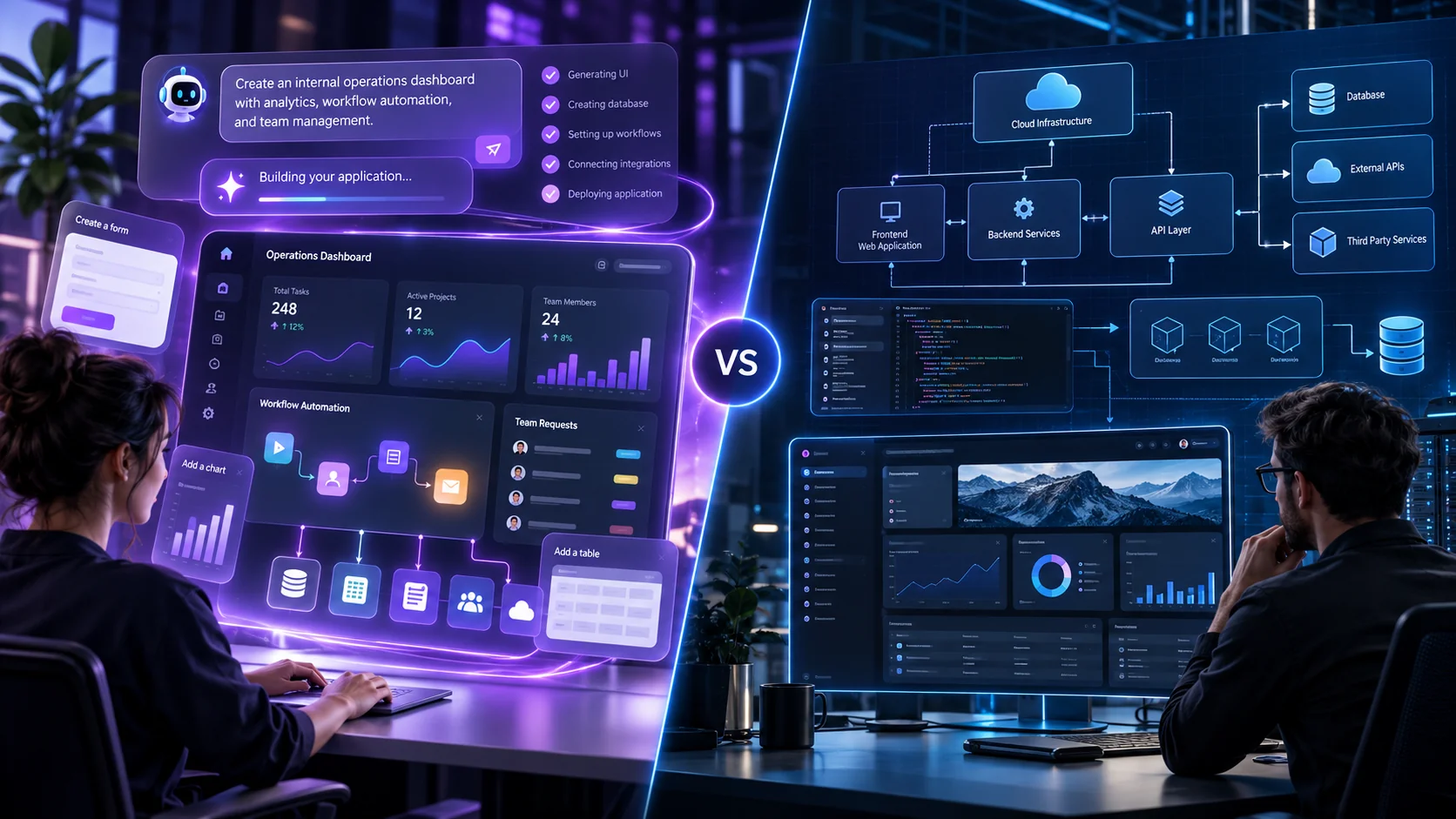
AI can now build working business applications from a written description.
That raises an obvious question.
Does your business still need custom software developers?
In September 2026, AWS made application building in Amazon Quick generally available.
The platform allows users to describe an application in natural language and create tools such as dashboards, project trackers and internal portals without traditional coding.
You can read the official AWS announcement.
This is part of a much larger trend.
AI coding agents, no-code platforms and conversational app builders are making software creation faster.
However, faster does not mean every application should be built the same way.
This guide compares an AI app builder vs custom software development so you can decide which approach fits your business.
What Is an AI App Builder?
An AI app builder lets users describe what they want in natural language.
The platform then generates an application or workflow.
For example, you might ask:
“Create a sales dashboard that displays opportunities from our CRM, allows managers to add notes and highlights deals that have not been updated in seven days.”
The system can create the interface and connect relevant data.
According to Amazon Quick’s application documentation, users can build interactive web applications through conversation and then publish them for their teams.
What Is Custom Software Development?
Custom software development means designing and building an application around specific business requirements.
The development team controls the:
- Frontend
- Backend
- Database
- APIs
- Business logic
- Authentication
- Infrastructure
- Integrations
- Deployment
Instead of working inside the limits of a platform, the application can be designed around the business.
This usually requires more time and budget.
However, it also provides much more control.
The Simple Answer: Neither Option Is Always Better
AI app builders are excellent for some problems.
Custom development is much better for others.
The right decision depends on:
- Who will use the application
- How complex the workflow is
- Whether external customers use it
- How much customization is needed
- Which systems must connect
- Security requirements
- Expected scale
- Long-term product strategy
When an AI App Builder Is a Good Choice
AI app builders can be extremely useful for internal tools.
Examples include:
- Internal dashboards
- Simple project trackers
- Employee portals
- Approval tools
- Training portals
- Data-entry interfaces
- Reporting tools
These applications usually serve a defined internal audience.
They may also rely on existing company data rather than creating an entirely new customer-facing product.
1. You Need an Internal Tool Quickly
Suppose your operations team is managing a workflow through spreadsheets.
The team needs a better interface.
However, the workflow is relatively straightforward.
An AI app builder may allow you to replace the spreadsheet quickly.
That can be more efficient than starting a full software project.
2. The Application Uses Existing Business Data
Platforms such as Amazon Quick can connect to existing company systems.
AWS says Quick supports connections with systems such as:
- Salesforce
- Jira
- Asana
- ServiceNow
- Microsoft 365
- Google Workspace
- Databases
- Data warehouses
Therefore, a company that mainly needs a better interface over existing information may not need a completely custom platform.
3. You Are Testing a Business Workflow
Before investing heavily, businesses can use AI app builders to validate an internal process.
For example, you might test whether a new approval workflow actually saves time.
If it works, you can keep the tool or later rebuild it with custom software.
4. Your Users Are Internal Employees
Internal applications often have simpler branding and user-experience requirements.
Employees may accept a standardized interface if the tool solves their problem.
Customers are different.
A customer-facing product often needs much more control over design and experience.
When Custom Software Development Is the Better Choice
An AI app builder becomes less suitable when the application itself is a core part of your business.
For example, imagine you are building:
- A SaaS product
- A marketplace
- A healthcare platform
- A customer portal
- An eCommerce platform
- A logistics application
- A financial workflow system
- A booking platform
- A large mobile application
These systems often require more control than a generic app-building environment provides.
1. Your Application Is the Product
If customers pay to use your software, the application is not simply an internal tool.
It is your product.
That changes the decision.
You may need full control over:
- Product experience
- Pricing logic
- Subscriptions
- Permissions
- Integrations
- Analytics
- Performance
- Deployment
In that case, custom development often provides a stronger foundation.
2. You Need Complete UI/UX Control
AI builders are designed to create applications quickly.
However, speed can come with design constraints.
If brand experience matters, you may need more control.
For example, a consumer-facing SaaS platform may require:
- A custom onboarding flow
- A unique dashboard
- Branded interactions
- Complex responsive behaviour
- Accessibility requirements
- Custom animations
Our UI/UX design services focus on designing those experiences around user behaviour rather than fitting them into a fixed template.
3. You Need Complex Business Logic
Simple workflows are easy to describe.
Complex workflows are different.
Imagine a multi-vendor marketplace.
An order may involve:
- Customer payment
- Vendor commission
- Inventory updates
- Shipping
- Cancellation rules
- Returns
- Partial refunds
- Tax
- Settlement reconciliation
That is not simply a dashboard.
It is a complex business system.
Custom software gives developers more precise control over those rules.
4. You Need Custom APIs and Integrations
No-code and AI platforms typically support a defined set of connectors.
That is convenient when your software is already supported.
However, your business may need a private API or a specialized partner system.
For example:
- Custom ERP
- Shipping provider
- Legacy database
- Industry-specific platform
- Payment gateway
- IoT device
Custom development allows developers to build the integration directly.
5. You Need a Public Customer-Facing Application
Internal tools and public products have different requirements.
A public application needs to consider:
- Unknown users
- Account registration
- Abuse prevention
- Performance
- Search visibility
- Payment security
- Large traffic spikes
- Customer support
That often requires more engineering than an internal AI app builder provides.
6. You Need a Mobile App
An internal browser-based tool is one thing.
A production Android and iOS application is another.
Mobile apps may require:
- Push notifications
- Camera access
- GPS
- Offline storage
- App Store deployment
- Play Store deployment
- Device permissions
Businesses needing these capabilities can explore our mobile app development services.
7. Security Requirements Are Complex
Security is not simply a checkbox.
It depends on what your application does.
Amazon Quick, for example, provides authentication, authorization and sandbox controls for its applications.
AWS explains these controls in its Quick application security documentation.
However, a business may have additional requirements.
These can include:
- Custom authorization models
- Country-specific data hosting
- Audit logs
- Encryption requirements
- Special compliance controls
Custom architecture may be necessary when these requirements become central to the product.
AI App Builder vs Custom Software Development: Quick Comparison
| Requirement | AI App Builder | Custom Development |
|---|---|---|
| Fast internal prototype | Strong fit | Often unnecessary |
| Internal dashboard | Strong fit | Depends on complexity |
| Customer-facing SaaS | Limited fit | Strong fit |
| Custom branding | May be limited | Full control |
| Complex integrations | Depends on connectors | High flexibility |
| Mobile application | Usually limited | Strong fit |
| Complex business logic | Can become difficult | Strong fit |
| Fast proof of concept | Excellent | Good but slower |
Should Startups Use AI App Builders for an MVP?
Sometimes.
The important question is what the MVP needs to prove.
If your MVP only needs to test an internal workflow, an AI builder may be ideal.
However, if the MVP needs to test customer behaviour inside the actual product experience, a generic internal tool may not provide the right evidence.
We explain this principle in our guide to building a focused SaaS MVP.
Will AI App Builders Replace Developers?
They will replace some development work.
That is already happening.
However, software development includes much more than generating screens.
Developers also make decisions about:
- Architecture
- Security
- Data models
- Performance
- Integrations
- Testing
- Deployment
- Failure handling
AI can accelerate many of those tasks.
It does not automatically remove the need for technical judgment.
AI Is Also Changing Custom Software Development
The comparison is not really:
AI versus developers.
The more useful comparison is:
platform-constrained AI building versus AI-assisted custom engineering.
Professional developers are also using AI to:
- Generate boilerplate
- Analyse code
- Create tests
- Debug issues
- Document systems
- Accelerate repetitive work
That can reduce development time while retaining architectural control.
What About AI Agents?
AI app builders and AI agents are related but different concepts.
An AI app builder creates an interface or workflow.
An AI agent can reason about a goal and take actions across systems.
For example, an agent might:
- Read a sales enquiry
- Classify the opportunity
- Check CRM information
- Create a task
- Send a response
We explain the production requirements in our guide to AI agent development.
Do You Need Microservices?
Probably not just because you are building custom software.
Architecture should match the product.
Small applications often work perfectly well as a structured monolith.
Microservices become useful when there is a real scaling or organizational reason.
Our article on when startups actually need microservices explains the trade-offs.
What Technology Stack Should Custom Software Use?
There is no single correct stack.
The right choice depends on:
- Product requirements
- Team skills
- Performance needs
- Integrations
- Expected scale
At NRS Technologies, many web applications use technologies such as:
- Next.js
- React
- Node.js
- TypeScript
- PostgreSQL
- MongoDB
- AWS
For backend decisions, you can also read our comparison of Node.js vs Python for backend development.
Can You Start With AI and Move to Custom Software Later?
Yes.
In fact, that can be a sensible strategy.
You can use an AI app builder to validate:
- Workflow
- User demand
- Required fields
- Approval logic
- Reporting requirements
Then, if the process becomes important enough, you can build a custom application around what you learned.
This reduces the risk of building the wrong system.
Questions to Ask Before Choosing
Ask your team:
- Is this an internal tool or a customer-facing product?
- How unique is our workflow?
- Do we need custom integrations?
- How important is branding?
- Will customers pay to use this software?
- How many users could we have?
- Do we need Android or iOS apps?
- What security controls are required?
- Can an existing platform solve 80% of the problem?
The answers usually make the direction much clearer.
How NRS Technologies Chooses Between AI Tools and Custom Development
At NRS Technologies, we do not recommend custom development simply because we can build it.
If an existing platform solves the problem reliably, using that platform may be the smarter decision.
However, custom development becomes valuable when the platform begins forcing your business to work around its limitations.
Our process usually starts by mapping:
- The business problem
- User roles
- Required workflows
- Integrations
- Data
- Security
- Future scale
Then we decide whether the project needs a custom application, automation, AI integration or an existing platform.
Planning a Business Application in 2026?
You do not need to decide the technology before discussing the idea.
Start with the problem.
Tell us what your team currently does manually.
Tell us who will use the system.
Then explain what you want the software to improve.
NRS Technologies can help determine whether you need:
- An AI app builder
- A simple automation
- A custom web application
- A mobile application
- An AI agent
- A larger software platform
Review our selected software projects to see examples of the systems we build.
You can also learn more about NRS Technologies and our engineering approach.
Discuss your application idea with NRS Technologies →
Frequently Asked Questions
What is an AI app builder?
An AI app builder allows users to describe an application in natural language and generate interfaces, workflows or connected internal tools without traditional software development.
Can AI build a complete business application?
AI can build useful applications for many internal workflows. However, customer-facing products with complex business logic, integrations, security or scale may still need custom engineering.
Is custom software development becoming unnecessary?
No. AI is reducing the effort required for some development tasks, but custom software remains useful when businesses need full control over architecture, functionality, design and integrations.
Should a startup use an AI app builder for its MVP?
It depends on what the MVP needs to validate. AI builders can be excellent for workflow prototypes. A customer-facing product may require custom development to test the real experience.
Can I move from a no-code AI app to custom software later?
Yes. Many businesses can validate a process with an AI or no-code tool and later build a custom system once the workflow is proven.
Does NRS Technologies build AI-powered applications?
Yes. NRS Technologies builds custom web and mobile applications and can integrate AI, automation, APIs and business workflows where they add measurable value.
Final Thoughts
AI app builders are a major improvement in how businesses create software.
They can turn weeks of internal-tool development into a much faster process.
That is valuable.
However, they do not make every custom application unnecessary.
The decision should depend on the problem.
Use an AI app builder when speed and simplicity matter more than total control.
Use custom development when the software is central to your product, customers or competitive advantage.
And sometimes, use both.
If you are unsure which route fits your project, send the requirement to NRS Technologies and we can help map the right approach.