
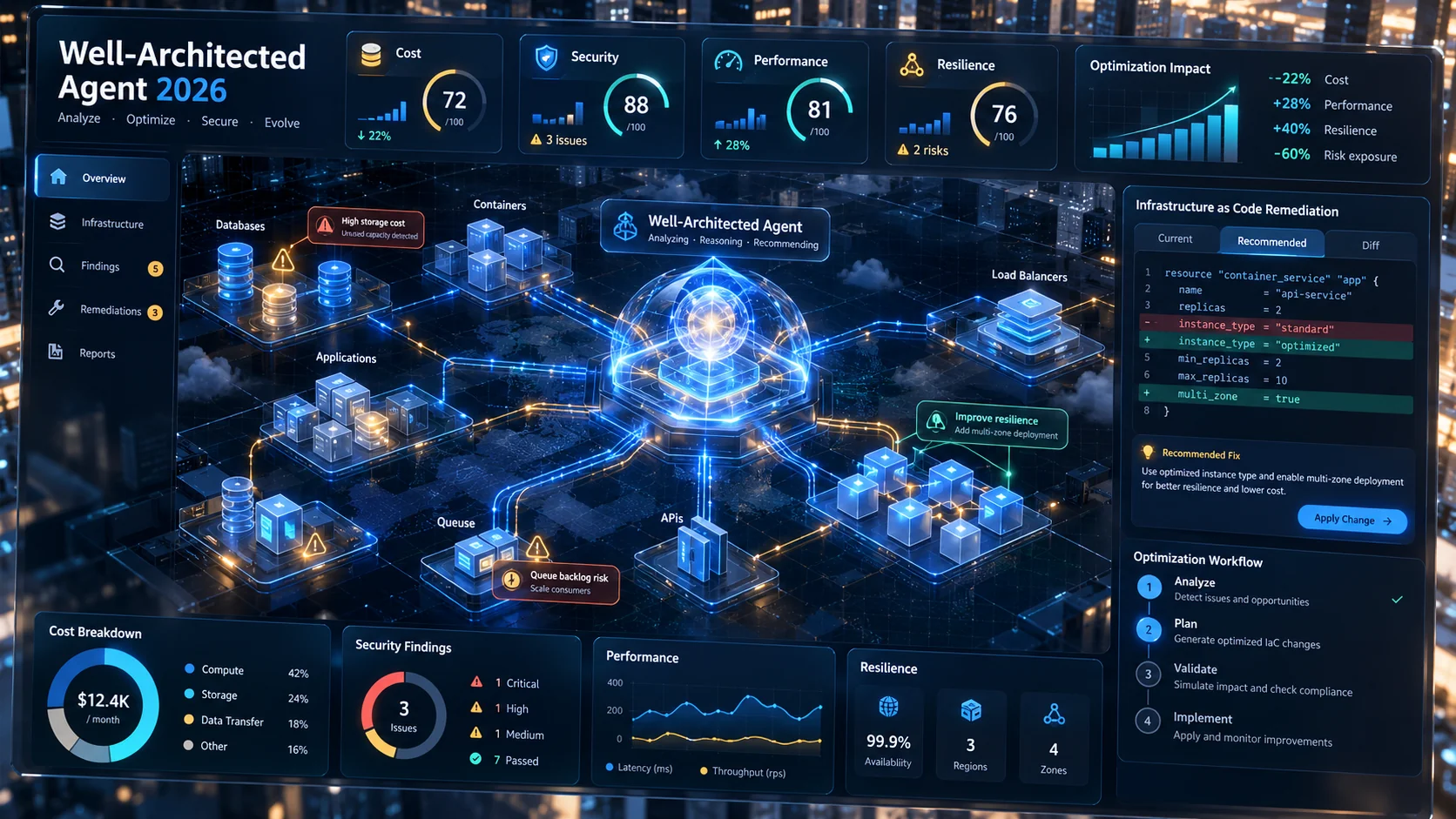
AWS can now use an AI agent to review your cloud architecture.
The new AWS Well-Architected Agent can analyse infrastructure for cost, security, performance and resilience.
It can even suggest implementation steps and Infrastructure as Code changes.
That raises an important question for businesses running on AWS.
Do you still need a cloud architect?
AWS launched the Well-Architected Agent in public preview on October 1, 2026.
The service analyses resource configurations, utilization data and application topology across more than 65 AWS services.
You can read the official AWS Well-Architected Agent announcement.
The tool is powerful.
However, AI-generated recommendations and real-world architecture decisions are not exactly the same thing.
This guide explains where the new agent can save time and where engineering judgment still matters.
What Is the AWS Well-Architected Agent?
The AWS Well-Architected Agent is an AI-powered cloud optimization service.
It builds on AWS’s existing Well-Architected and Trusted Advisor concepts.
Instead of presenting only generic findings, the agent can consider your:
- AWS resources
- Application structure
- Utilization
- Business priorities
It then provides prioritized recommendations.
AWS says recommendations can cover:
- Cost optimization
- Security
- Performance
- Resilience
You can also review AWS’s official preview availability announcement.
Why AWS Cloud Architecture Reviews Matter
Cloud infrastructure often grows gradually.
A startup may begin with:
- One server
- One database
- One storage bucket
Then the product grows.
Teams add:
- More compute
- Load balancers
- Containers
- Queues
- Caches
- CDNs
- Monitoring
- Backups
After several years, nobody may have a complete picture of why every resource exists.
That is where architecture reviews become valuable.
1. The Agent Can Review AWS Cost
Cloud waste is common.
Examples include:
- Oversized instances
- Unused storage
- Idle databases
- Old snapshots
- Unnecessary data transfer
- Resources running outside business hours
AWS says its new agent can combine infrastructure information with business goals to prioritize recommendations.
That is more useful than simply saying:
“This resource is expensive.”
The better question is:
“Can we reduce this cost without hurting performance or reliability?”
2. The Agent Can Review Security
Security is another core Well-Architected area.
A cloud review can identify issues around:
- IAM
- Public access
- Encryption
- Network configuration
- Logging
- Backup strategy
However, a finding still needs business context.
A recommendation that is correct for one application may not fit another.
3. It Can Review Performance
Cloud cost and performance often pull in opposite directions.
A smaller server may save money.
However, it may also slow down the application.
A good architecture review must consider both.
AWS says its new agent can show cross-pillar trade-offs.
That is one of its most useful ideas.
4. It Can Review Resilience
Resilience asks:
“What happens when something fails?”
That can include:
- Database failure
- Server failure
- Region problems
- Deployment errors
- Unexpected traffic
A highly available application may require:
- Multiple availability zones
- Backups
- Replication
- Health checks
- Failover
However, those capabilities also cost money.
The correct architecture depends on how much downtime the business can tolerate.
5. AWS Can Analyse Terraform, CloudFormation and CDK
This is particularly useful for engineering teams.
The Well-Architected Agent can analyse Infrastructure as Code before production.
AWS lists support for:
- Terraform
- AWS CloudFormation
- AWS CDK
The service can identify architecture gaps and return suggested code changes.
This can move cloud reviews earlier in the development lifecycle.
6. The Agent Can Generate Remediation Guidance
Traditional audit tools often stop at:
“Here is the problem.”
AWS is trying to move closer to:
“Here is the problem, why it matters, and how you could fix it.”
Depending on the finding, remediation guidance may include:
- Console steps
- CLI commands
- Updated IaC
- SSM runbooks
That can reduce the time between finding and remediation.
Does the AWS Agent Automatically Change Infrastructure?
The system can generate remediation recommendations and automation-ready instructions.
However, businesses should still review changes before applying them to critical environments.
AWS itself notes that generative AI recommendations can contain errors or incomplete information.
Therefore, human oversight remains important.
Can AI Replace a Cloud Architect?
For routine reviews, AI can remove a lot of manual effort.
That is valuable.
However, cloud architecture involves decisions that depend on business context.
For example:
Should this database be Multi-AZ?
Technically, higher availability may be better.
However, the decision also depends on:
- Application importance
- Downtime tolerance
- Budget
- Recovery requirements
The AI can explain the trade-off.
A person still needs to decide which trade-off the business accepts.
AWS Well-Architected Agent vs Cloud Architect
| Task | AWS Agent | Cloud Architect |
|---|---|---|
| Scan resources | Excellent | Slower manually |
| Find common misconfigurations | Strong | Strong |
| Generate remediation guidance | Strong | Strong |
| Understand business politics | Limited | Strong |
| Choose risk tolerance | Can advise | Human decision |
| Plan complex migration | Can assist | Strong |
| Own production outcome | No | Yes |
When the AWS Agent Can Save Your Team Time
The tool can be especially useful for:
- Regular architecture reviews
- Cost audits
- IaC reviews
- Finding obvious security gaps
- Prioritizing remediation
This means engineers can spend less time collecting findings manually.
When You Still Need Engineering Support
A recommendation is not the same as implementation.
You may still need developers or cloud engineers when:
- The application has downtime constraints.
- Database changes require migration.
- Infrastructure is tightly coupled.
- Authentication may be affected.
- The proposed change modifies networking.
- The application must be load tested.
AWS Cost Optimization Should Start With Architecture
Teams often try to reduce AWS bills by simply selecting smaller servers.
That can help.
However, bigger savings may come from architectural changes.
For example:
- Removing unused resources
- Using caching correctly
- Optimizing storage
- Adjusting database strategy
- Using autoscaling
- Reducing unnecessary data transfer
The cheapest instance is not always the cheapest architecture.
Do Not Optimize Cloud Cost Without Measuring Performance
Suppose an application currently responds in 300 milliseconds.
A cheaper infrastructure configuration reduces the bill by 20%.
However, response time increases to three seconds.
That might be a bad trade.
Cost, performance and user experience need to be evaluated together.
Security Recommendations Need Testing Too
A security improvement can still break an application.
For example, tightening an IAM permission may stop a legitimate process.
Therefore:
Review → Test → Deploy → Monitor.
Do not blindly apply large infrastructure changes directly to production.
Use Infrastructure as Code Where Possible
Infrastructure as Code makes environments easier to review and reproduce.
It can also make AI-assisted architecture review more useful.
If the entire environment exists only through manual console changes, understanding the current state can be more difficult.
Tools such as Terraform and AWS CDK make architecture more explicit.
How Often Should You Review AWS Architecture?
A cloud architecture should not be reviewed only when something breaks.
Review it after major events such as:
- Large traffic growth
- Major product launch
- Database migration
- Security incident
- Rapid cloud-cost increase
- Major architecture change
AWS documentation says the Well-Architected Agent can also refresh recommendations on an ongoing basis.
What About Small Startups?
A small startup does not need enterprise-level architecture everywhere.
Overengineering creates its own cost.
A startup may reasonably choose:
- One region
- A simpler deployment
- Managed services
- Limited redundancy
Then improve resilience as the product becomes more valuable.
Architecture should match business risk.
When AWS Cost Becomes a Warning Sign
Investigate when your AWS bill grows faster than:
- Users
- Revenue
- Transactions
- Stored data
That may indicate inefficient infrastructure.
However, higher cost can also be legitimate if usage has changed.
Start with measurement before optimization.
How NRS Technologies Builds AWS-Hosted Applications
At NRS Technologies, cloud architecture is part of building reliable applications.
Our projects can include technologies such as:
- Next.js
- Node.js
- PostgreSQL
- AWS
- Docker
- Object storage
- CDNs
- Managed databases
The goal is not to use every AWS service.
The goal is to build an architecture that matches the application.
Do You Need Microservices to Be Well Architected?
No.
A well-designed monolith can be better than unnecessary microservices.
Architecture quality is not measured by the number of services.
Our guide to when startups actually need microservices explains why complexity should be justified by real requirements.
Combine AI Recommendations With Application Knowledge
The AWS agent understands infrastructure.
Your application team understands:
- Customer behaviour
- Release schedules
- Business priorities
- Legacy dependencies
- Expected growth
The strongest review combines both.
What Should AWS Teams Do Now?
If your business runs important workloads on AWS, start with a simple checklist.
- Review your current monthly AWS cost.
- Identify critical applications.
- Check backup and recovery strategy.
- Review IAM permissions.
- Document major architecture components.
- Review performance metrics.
- Evaluate the new Well-Architected Agent if eligible.
- Test recommendations before production.
Need an AWS Cloud Architecture Review?
An AI cloud-review tool can find valuable issues.
However, businesses still need to decide what to change and how to change it safely.
NRS Technologies can help review:
- AWS architecture
- Application deployment
- Database design
- Docker workloads
- Cloud cost
- Performance bottlenecks
- Security configuration
- Migration requirements
If your architecture needs application changes too, our web application development team can work across both software and infrastructure.
You can also review our selected development projects and learn more about NRS Technologies.
Ask NRS Technologies to review your AWS application architecture →
Frequently Asked Questions
What is the AWS Well-Architected Agent?
The AWS Well-Architected Agent is an AI-powered service that reviews AWS environments and provides prioritized recommendations across areas such as cost, security, performance and resilience.
When was the AWS Well-Architected Agent released?
AWS announced the public preview on October 1, 2026.
Can AWS Well-Architected Agent review Terraform?
Yes. AWS says the agent can perform architecture reviews on Infrastructure as Code projects including Terraform, AWS CloudFormation and AWS CDK.
Can the AWS agent reduce my cloud bill?
It can identify cost-optimization opportunities and estimate financial impact for some findings. However, businesses should evaluate recommendations against performance, reliability and operational requirements.
Can AWS Well-Architected Agent replace a cloud architect?
It can automate many review and recommendation tasks. However, architecture still requires business-context decisions, implementation planning, testing and accountability.
Should AI-generated AWS changes be applied automatically?
Critical infrastructure changes should be reviewed and tested before production. AWS also notes that generative AI recommendations may contain errors or incomplete information.
Does NRS Technologies work with AWS-hosted applications?
Yes. NRS Technologies builds and maintains web applications using AWS, databases, Docker, APIs and modern JavaScript technologies.
Final Thoughts
The AWS Well-Architected Agent is a useful development for cloud teams.
It can make architecture reviews faster.
It can identify problems earlier.
And it can reduce the manual work needed to produce remediation guidance.
However, AI recommendations do not remove engineering responsibility.
A production environment still needs people who understand the application, the business and the consequences of each change.
Use AI to accelerate the review.
Use engineering judgment to decide what belongs in production.
If your AWS bill is growing, your architecture has become difficult to maintain, or you want an independent technical review, contact NRS Technologies for an AWS application and architecture review.