
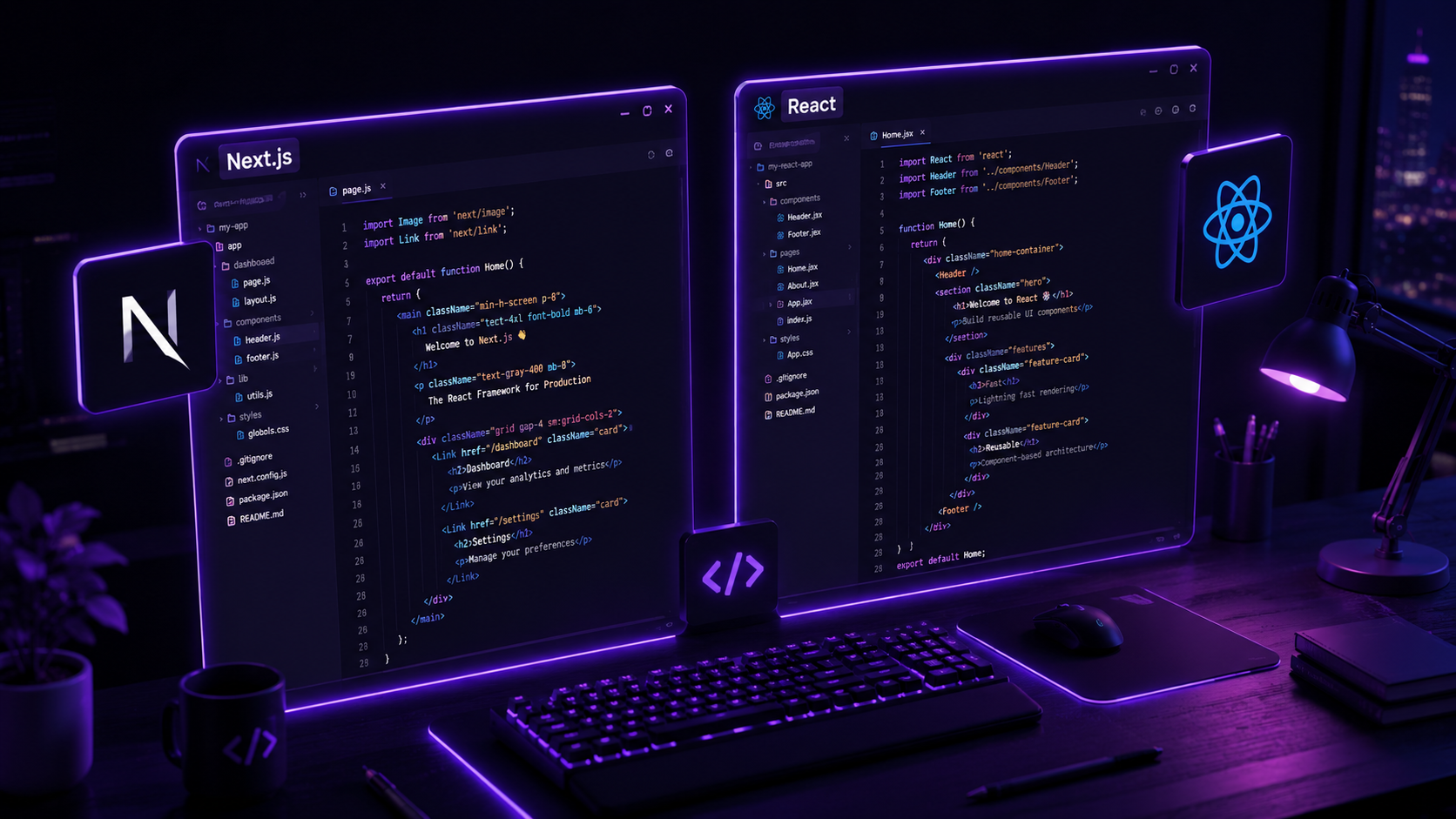
One of the most common questions we hear from founders evaluating a web development company in Hyderabad is: “Should we build on Next.js or plain React?” It’s a fair question — and the wrong choice can quietly cost you SEO rankings, performance, and months of rework down the line.
What Is Next.js and React?
React is a JavaScript library for building user interfaces through reusable components. It’s the engine, not the car — React alone doesn’t dictate routing, rendering strategy, or SEO handling.
Next.js is a framework built on top of React that adds server-side rendering, static site generation, routing, image optimization, and API routes out of the box. Think of it as React with the missing pieces filled in for production-grade applications.
Key Differences: SSR, SSG, and SEO
Plain React apps typically render entirely in the browser (client-side rendering), which means search engines initially see a mostly empty page until JavaScript executes. This can hurt SEO for content-heavy sites.
Next.js solves this with Server-Side Rendering (SSR) and Static Site Generation (SSG) — the HTML is built on the server or at build time, so search engines and users see fully-formed content immediately. Google’s own guidance on rendering strategies explains why this distinction matters so much for crawlability and Core Web Vitals.
Performance-wise, Next.js also handles image optimization, code splitting, and font loading automatically — areas where a plain React app requires significant manual configuration.
When to Choose Next.js
Next.js is the right call when:
- SEO is critical (marketing sites, blogs, eCommerce, landing pages)
- You need fast initial page loads for cold visitors
- You want built-in API routes without a separate backend for simple use cases
- You’re deploying on platforms like Vercel, which is built specifically for Next.js
When to Choose React
Plain React (often paired with Vite) makes more sense for:
- Internal dashboards and admin panels where SEO is irrelevant
- Single-page applications (SPAs) behind a login
- Highly interactive tools where server rendering adds unnecessary complexity
The Patterns.dev resource is a great reference for understanding these architectural trade-offs in more depth.
How NRS Technologies Uses Both
We don’t force every client into one framework. Our typical approach:
- Public-facing marketing sites, eCommerce stores, and blogs → Next.js, for SEO and speed
- Internal tools, dashboards, and admin panels → React (often with Vite), for fast iteration and simplicity
- Full-stack products → Next.js frontend + Node.js/Express microservices backend
This hybrid approach means you’re never over-engineering a simple internal tool, and never under-optimizing a public site that needs to rank.
Cost and Timeline Comparison
| Factor | Next.js | Plain React |
|---|---|---|
| SEO readiness | Built-in | Requires extra work |
| Initial setup time | Slightly longer | Faster |
| Hosting | Vercel, AWS, custom | Any static host |
| Best for | Public sites, eCommerce | Dashboards, SPAs |
According to npmtrends data, Next.js adoption has grown consistently year over year, reflecting how much of the industry now defaults to it for production apps — a trend also visible in tooling coverage from Chrome DevTools’ Lighthouse documentation on rendering performance.
Final Thoughts
There’s no universally “better” framework — only the right tool for your specific product. If SEO and speed to first paint matter, Next.js almost always wins. If you’re building something purely interactive behind a login wall, React alone can be simpler and faster to ship.
Ready to get started? Contact NRS Technologies at hello@nrstechnologies.com or visit nrstechnologies.com/contact for a free technical consultation.