
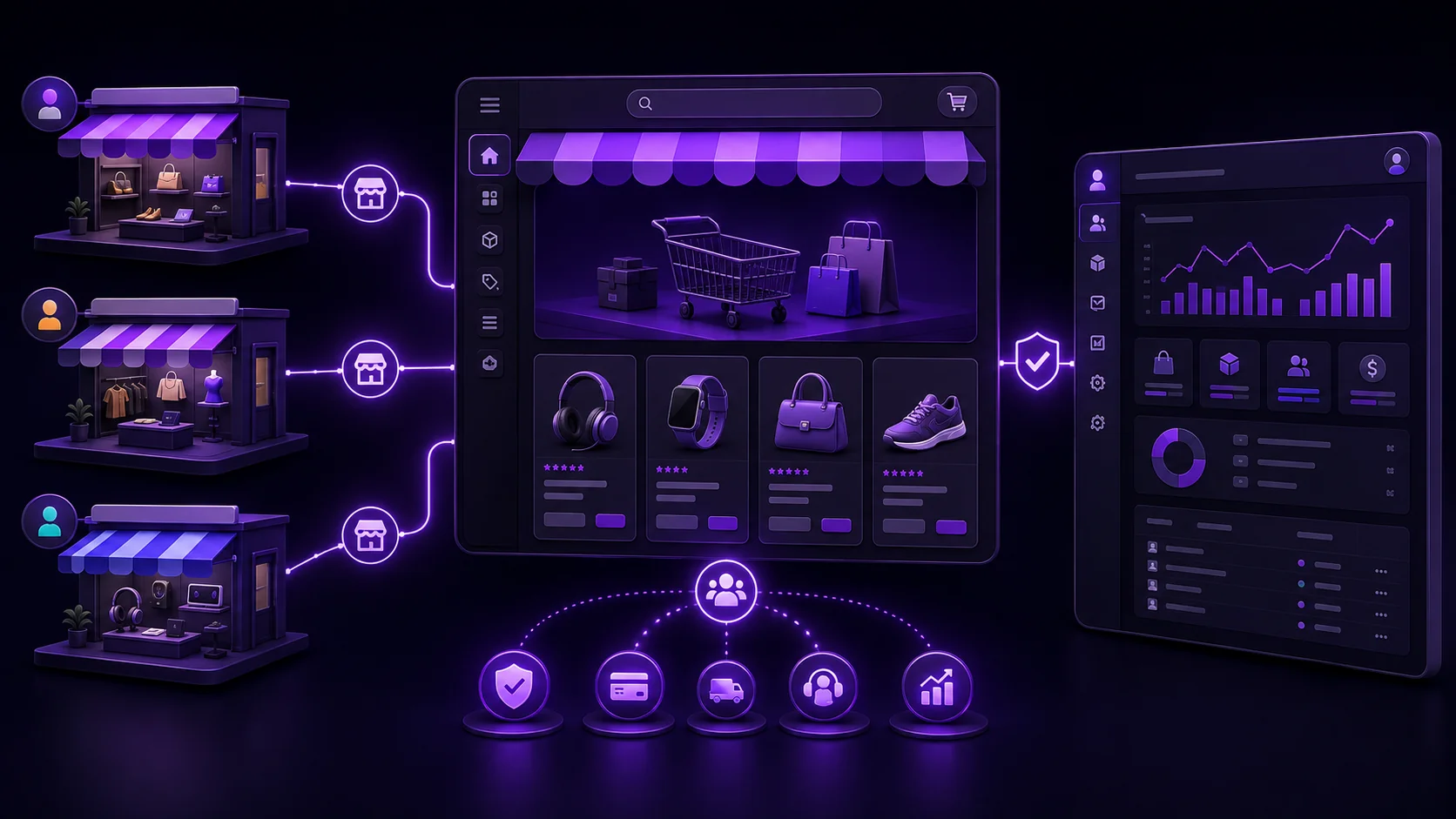
Building a marketplace is a fundamentally different challenge than building a single-vendor store. That’s the reality behind every multi-vendor marketplace development Hyderabad inquiry we get from founders with ambitious platform ideas.
As an eCommerce development company in Hyderabad, we’ve built marketplaces across categories. Here’s what actually goes into one.
What Makes a Marketplace Different From a Store
A single-vendor store has one seller, one inventory, one set of policies. A marketplace has many independent vendors, each with their own inventory, pricing, and fulfillment — all coordinated through your platform.
This multiplies complexity significantly. Every feature needs to account for multiple, sometimes competing, vendor interests.
Core User Roles in a Marketplace
Three distinct user types need dedicated experiences:
- Buyers — browsing, purchasing, and tracking orders across multiple vendors
- Vendors — managing their own listings, inventory, and order fulfillment
- Admins — overseeing the entire platform, resolving disputes, and managing commissions
Each role needs its own dashboard, built around genuinely different workflows and priorities.
Vendor Onboarding and Verification
A smooth vendor onboarding process directly affects how many quality sellers join your platform. Verification steps — business documentation, bank details for payouts — need to balance thoroughness against friction that discourages legitimate vendors from completing signup.
Automate what you can here. Manual verification bottlenecks become a real scaling problem as vendor volume grows.
Commission and Payout Structures
Your platform needs clear, automated commission calculation on every sale, along with a reliable payout schedule to vendors. Getting this wrong — delayed or incorrect payouts — damages vendor trust faster than almost any other platform issue.
Consider offering multiple commission tiers based on vendor volume or category, which can incentivize your best-performing sellers to stay active.
Product Catalog Management at Scale
With many vendors listing products, maintaining catalog quality becomes genuinely difficult. Standardized listing templates, required fields, and automated duplicate detection all help maintain consistency across thousands of vendor-submitted listings.
Search and Discovery Across Vendors
Buyers need to find products regardless of which vendor lists them. This requires unified search and filtering that works seamlessly across your entire multi-vendor catalog, not siloed by individual seller.
Category structure and search relevance both need careful design here, since a confusing catalog structure hurts every vendor on your platform simultaneously.
Dispute Resolution and Trust
With multiple independent vendors, disputes over quality, shipping delays, or returns are inevitable. A clear, documented resolution process protects both buyers and legitimate vendors, while giving your admin team the tools to intervene when needed.
Recommended Technology Approach
Custom-built marketplaces typically use Next.js for the frontend, Node.js for backend services, and a well-designed database schema separating vendor, product, and order data cleanly from the start. Payment infrastructure needs to support split payments, routing the correct amount to each vendor automatically after commission deduction.
How NRS Technologies Builds Marketplace Platforms
We architect marketplaces around the three core roles — buyer, vendor, admin — from the earliest planning stages, not as an extension of a single-vendor store template. Our eCommerce development services cover this full marketplace build process.
As a result, clients launch platforms that scale with vendor growth instead of breaking under it. Our web development services also support the complex backend logic marketplace commission and payout systems require.
Frequently Asked Questions
How is a multi-vendor marketplace different from a regular online store? A marketplace supports many independent vendors, each with their own inventory and fulfillment, requiring dedicated buyer, vendor, and admin experiences rather than a single-seller structure.
How long does it take to build a marketplace platform? A focused MVP typically takes several months, depending on vendor onboarding complexity, payment infrastructure, and how many features are included at launch.
How do commission and payout systems work on a marketplace? The platform automatically calculates commission on each sale and processes payouts to vendors on a set schedule, with split payment infrastructure routing correct amounts after deduction.
What’s the biggest operational challenge in running a marketplace? Maintaining vendor quality and resolving disputes fairly at scale, since a poor experience with one vendor can damage trust in the entire platform.
Should a marketplace be built on an existing platform or custom-built? It depends on complexity. Simple marketplaces can use existing plugins, but platforms requiring custom commission structures or unique workflows typically need custom development.
How important is vendor onboarding to marketplace success? Very important. A smooth, well-verified onboarding process directly affects both the quality and quantity of vendors joining your platform early on.
Final Thoughts
Marketplace platforms reward businesses that plan for multi-role complexity from the start. Getting vendor onboarding, commission structures, and dispute resolution right early prevents costly platform-wide trust issues later.
Ready to get started? Contact NRS Technologies at hello@nrstechnologies.com or visit nrstechnologies.com/contact for a free marketplace development consultation.